
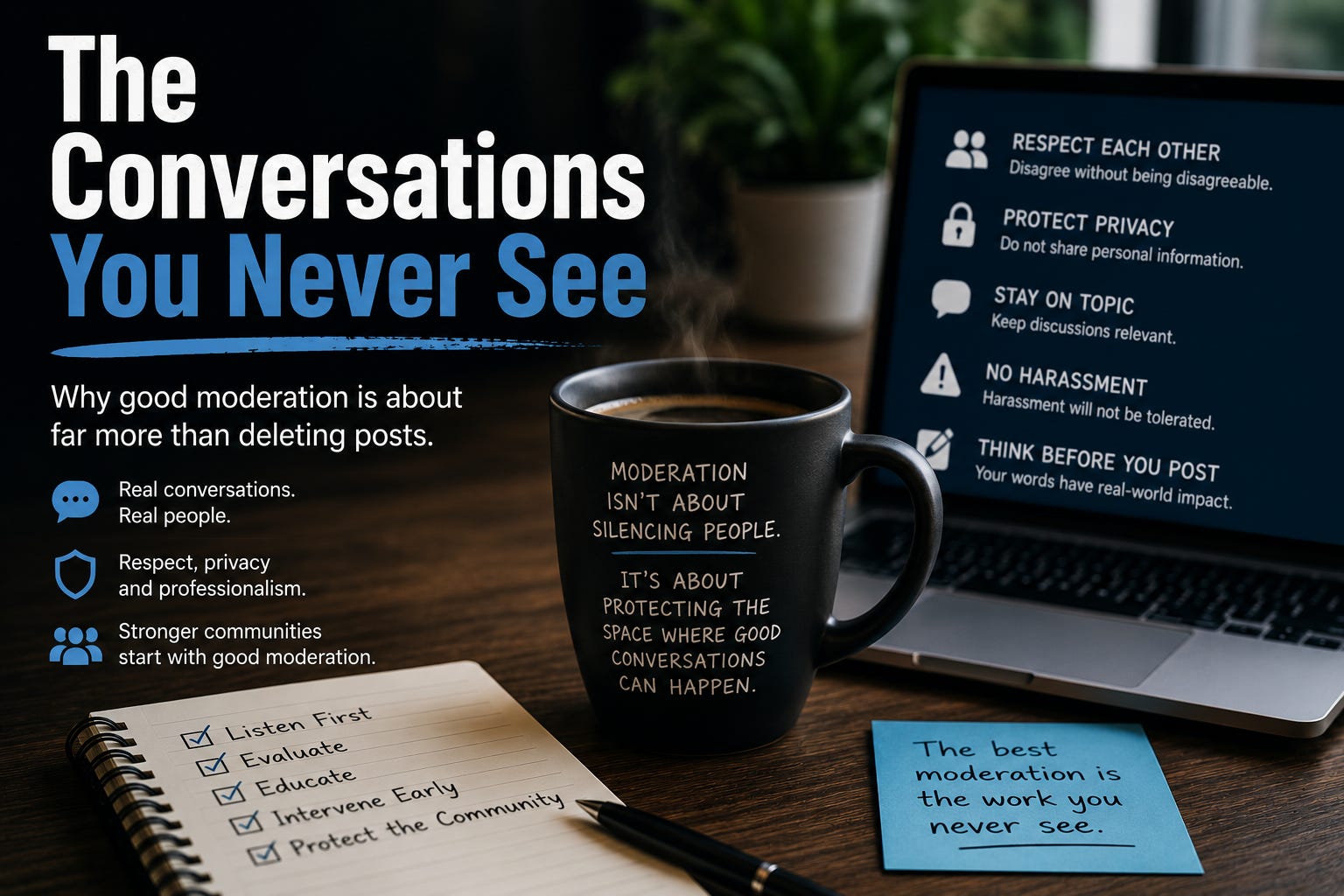
If you’ve followed my writing for any length of time, you’ve probably noticed that I come back to social media moderation quite a bit. To be honest, it’s not because I particularly enjoy talking about it. It’s because, after years of managing large online communities, I’ve learned that it’s one of those topics people rarely think about until something goes wrong.
Every few weeks I’m either updating community guidelines, reviewing our Terms of Use, explaining why a post was removed, or having another conversation about what is, or isn’t, appropriate to post in a professional online community. Sometimes those conversations are well received. Other times they’re met with frustration or accusations that moderation is somehow censorship. I’ve become accustomed to both.
The reality is that moderation is far more complicated than most people realize. It’s not about controlling opinions or deciding who gets to speak. Good moderation is about protecting the purpose of a community. Whether it’s a union group, a professional association, or even a neighbourhood Facebook page, every online community exists for a reason. Without some level of moderation, those spaces almost always drift toward conflict, misinformation, personal attacks, or a handful of people dominating every conversation. Eventually, the people who simply wanted to ask questions, learn something, or contribute quietly stop participating altogether.
What has surprised me over the years is how little moderation actually involves deleting posts or banning people. Most of the work happens long before it ever reaches that stage. It’s about making dozens—sometimes hundreds—of small judgement calls every week. Can someone reword a post instead of removing it? Is a comment simply expressing frustration, or is it creating unnecessary legal or professional risk? Could that photo identify a patient? Could that joke be interpreted very differently by an employer, a regulator, or a journalist? Those are the kinds of decisions moderators make every day, and they’re rarely as black and white as people think.
One thing I’ve noticed is that people often don’t really appreciate those risks until someone gets hurt by them. Every time a healthcare worker, police officer, teacher, or public servant is disciplined because of something they posted online, there’s a flurry of conversations about professionalism, privacy, and social media. People become more cautious for a little while. Then, gradually, things settle down and many fall back into the same habits. Unfortunately, by then it’s usually too late for the person at the centre of the story.
That’s one of the reasons I spend so much time talking about moderation. It’s also why I occasionally update the Terms of Use in the communities I manage. Technology is changing faster than any of us can keep up with. Artificial intelligence has made it easier than ever to create convincing images, videos, and misinformation. Social media platforms continue to evolve, and so do the legal, professional, and reputational risks that come with using them. Good governance isn’t something you write once and forget about. It has to evolve along with the community it’s meant to protect.
One of the things I’m most proud of over the past several years isn’t the number of followers we’ve gained or the amount of engagement we’ve generated. It’s the fact that serious disciplinary issues arising from our union-managed social media communities have become increasingly rare. That didn’t happen by accident. It happened because difficult conversations were had early, expectations were made clear, and, where necessary, moderation happened before a problem became something much bigger. Those conversations aren’t always popular, but I’d much rather have an uncomfortable discussion today than help someone deal with employer discipline tomorrow.
What many people never see is the work that happens behind the scenes. Social media doesn’t stop at five o’clock. It doesn’t take weekends off, and it certainly doesn’t care if you’re on vacation. Questions come in late at night. News breaks on holidays. Rumours spread in real time. Moderation often means making quick decisions with incomplete information, knowing that no matter what you decide, someone is probably going to disagree.
I’ve also learned that the best moderation is almost invisible. Most people never see the privacy breach that was prevented, the defamatory comment that was removed before it spread, or the member who quietly edited a post after a respectful conversation instead of finding themselves sitting in an employer’s investigation meeting. Success is often measured not by what happened, but by what never did.
People often frame moderation as a battle between free speech and censorship, but I don’t think that’s the right conversation. You’re absolutely free to have opinions, to disagree with people, and to challenge ideas. Healthy communities depend on that. But every community also has the right—and I’d argue the responsibility—to establish expectations about how those conversations take place. That’s not censorship. It’s simply good stewardship.
At the end of the day, moderation isn’t really about removing content. It’s about protecting a space where people feel comfortable asking questions, sharing experiences, disagreeing respectfully, and learning from one another without unnecessary conflict or risk. In a world where outrage is rewarded and misinformation travels faster than facts, I think those spaces have become more important than ever.
Maybe that’s why I keep coming back to this topic.
Not because I enjoy talking about moderation, but because I’ve seen what happens when nobody does.
IAN TAIT